The Fractured Himalaya: India China Tibet 1949-62 by Nirupama Rao
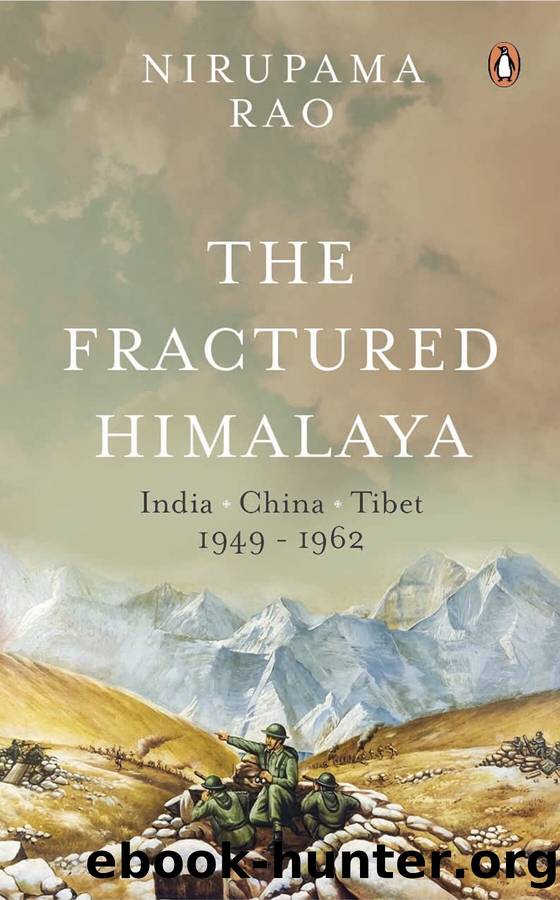
Author:Nirupama Rao
Language: eng
Format: epub
ISBN: 9789354922886
Publisher: Penguin Group
Published: 2021-10-09T00:00:00+00:00
12
The Unravelling
âWhat aim did Chinese comrades pursue in attacking Nehru so uncompromisingly? According to Comrade Mao Zedong, they unmask Nehru as a âdouble-dealerâ, âhalf a man, half a devilâ, âhalf a gentleman, half a hooliganâ.1
âMikhail Suslov, Soviet Communist Party ideologue reporting on a visit to China, 1959
If 1958 displayed signs of an unforeseen turbulence in Indiaâs relations with China, the events to come in 1959 portended far worse. To the troubles brewing in the context of an unresolved boundary question, were to be added the aftermath of a widespread revolt against Chinese presence in Tibet, and the resultant flight of the Dalai Lama to India. Together with this came the first incidents of bloodshed involving the loss of life of Indian personnel in the border areas. All these events contributed to deepening anti-China public sentiment within India. The halcyon days of the âfriendship of one billionâ were clearly over. The internal situation within China was also far from normal. Maoâs Great Leap Forward had proved disastrous for the country with widespread famine, rural distress and deprivation, drastic economic decline and millions of deaths from hunger and starvation. The Indian Embassy in Beijing reporting on the situation surmised that âChina may resort to diversionary tactics and assume an international violent posture to wade over internal difficultiesâ.2
Internal political struggles within the leadership of the Communist Party also resulted in Mao Zedong adopting far more radicalized policies both on the domestic and foreign policy fronts. Tensions with the Soviet Union were growing over the latterâs espousing a policy of greater dialogue with the United States. Nor did Soviet warmth towards a non-aligned India please the Chinese. Nehruâs successful visit to Washington for talks with President Eisenhower in the winter of 1956 was another cause for concern in Beijing. The US and its western allies were now more willing than before to assist Indiaâs economic development plans despite prior differences over its non-aligned status. They were also aware of the growing differences with China over the border issue. The failure of Chinaâs economic programme and the disastrous Great Leap had lowered Chinese prestige. In the words of Allen Dulles, the CIA Director, the âimage of Mao as the âall-wise fatherâ has been somewhat impaired.â3 In such a situation, it has been argued that it suited China to bring the differences with India over the border and over the Aksai Chin into the open, in order to âunderline the power of China and show its importanceâ and to show India as a âsoft target.â4
Meanwhile in Tibet, tensions were mounting. The Chinese communists led by Mao, for their part, saw Tibet as a profoundly backward place, ridden with feudal societal values, and needing the reform-minded policies of the Chinese Communist Party. Insensitivity to Tibetan culture and history was a given. There was therefore, an inbuilt rift between the Chinese and the Tibetans that widened in the years from 1950 onwards.
In early March 1959, Chinese Foreign Minister Chen Yi spoke to the Charge dâAffaires at the Indian Embassy in Beijing, I.
Download
This site does not store any files on its server. We only index and link to content provided by other sites. Please contact the content providers to delete copyright contents if any and email us, we'll remove relevant links or contents immediately.
Personalized inhaled bacteriophage therapy for treatment of multidrug-resistant Pseudomonas aeruginosa in cystic fibrosis by unknow(214837)
CONSORT 2025 statement: updated guideline for reporting randomized trials by unknow(102521)
Critical evaluation of the ProfiLER-02 study design and outcomes by Vivek Subbiah & Razelle Kurzrock(102046)
Cardiac gene therapy makes a comeback by Oliver J. Müller & Susanne Hille & Anca Kliesow Remes(101838)
Whisky: Malt Whiskies of Scotland (Collins Little Books) by dominic roskrow(74620)
Unveiling the design rules for tunable emission in graphene quantum dots: A high-throughput TDDFT and machine learning perspective by Şener Özönder & Mustafa Coşkun Özdemir & Caner Ünlü(51002)
A yeast-based oral therapeutic delivers immune checkpoint inhibitors to reduce intestinal tumor burden by unknow(40374)
Covalent hitchhikers guide proteins to the nucleus by Alexander F. Russell & Madeline F. Currie & Champak Chatterjee(40296)
Meet the Authors: Christopher R. Mansfield and Emily R. Derbyshire by Christopher R. Mansfield & Emily R. Derbyshire(40209)
Alkaline-earth metals promote propane dehydrogenation with carbon dioxide through geometric effects: Altering the reaction pathway by unknow(32814)
Induced iron vacancies boosting FeOOH loaded on sustainable Fenton-like collagen fiber membrane for efficient removal of emerging contaminants by unknow(32611)
Efficient electric-field-assisted photochemical conversion of methane to n-propanol exclusively over penetrated TiO2Ti hollow fibers by Guanghui Feng(32530)
Bi2SiO5 nanosheets as piezo-photocatalyst for efficient degradation of 2,4-Dichlorophenol by Hangyu Shi & Yifu Li & Lishan Zhang & Guoguan Liu & Qian Zhang & Xuan Ru & Shan Zhong(32469)
A novel NDIPTA organic heterojunction photocatalyst with built-in electric field for efficient hydrogen production by Jiahui Yang & Baojun Ma & Yongfa Zhu(32443)
Enhanced conversion of methane to liquid-phase oxygenates via hollow ferrite nanotube@horseradish peroxidase based photoenzymatic catalysis by Jun Duan & Shiying Fan & Xinyong Li & Shaomin Liu(32405)
Ordered macroporous superstructure of defective carbon adorned with tiny cobalt sulfide for selective electrocatalytic hydrogenation of cinnamaldehyde by Xiao-Shi Yuan & Sheng-Hua Zhou & San-Mei Wang & Wenbo Wei & Xiaofang Li & Xin-Tao Wu & Qi-Long Zhu(32335)
What's Done in Darkness by Kayla Perrin(27260)
Topological analysis of non-conjugated ethylene oxide cored dendrimers decorated with tetraphenylethylene: Insights from degree-based descriptors using the polynomial approach by A Theertha Nair & D Antony Xavier & Annmaria Baby & S Akhila(26631)
Investigation of mechanical and self-healing properties of hydroxyl-terminated polybutadiene functionalized with 2-ureido-4-pyrimidinone by Mohsen Kazazi & Mehran Hayaty & Ali Mousaviazar(26555)
